
THE Fastest Way to Arrange a Track
If you struggle to finish tracks, you’re not alone. Here’s the fastest way to arrange a track!
Most producers don’t fail because their sounds are bad. They fail because they don’t know how to arrange a track quickly without overcomplicating it.
The good news? There’s a much simpler way!
In this guide, you’ll learn the fastest way to arrange a track using one core chord progression — and how to turn it into a full song without adding more chords or changing key.
This approach works across EDM, melodic techno, house, pop, and beyond.
Why Most Producers Get Stuck Arranging Tracks
Most chord progression tutorials teach you what chords to use.
What they don’t teach is how to use a chord progression over three to six minutes without it getting boring.
This is where many producers go wrong.
They assume the solution is:
- Adding more chords
- Changing key
- Writing multiple progressions
In reality, most professional tracks don’t do this.
They rely on one main progression and arrange it intelligently.
Micro VS Macro Chord Progressions
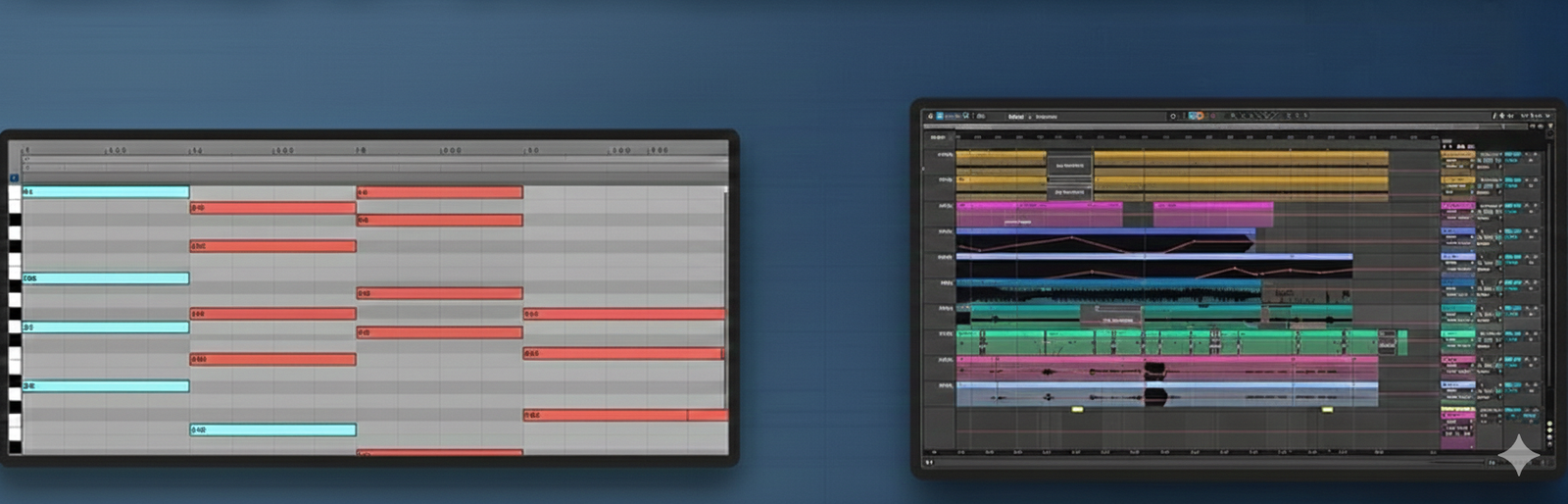 To understand the fastest way to arrange a track, think in two layers.
Micro Chord Progression
The micro chord progression is your core musical idea.
It’s usually:
- 2 to 4 chords
- In a single key
- Repeated throughout the track
This progression is the emotional foundation of the song.
Macro Chord Progression
The macro chord progression is how that same idea is used over time.
Instead of changing chords, you change:
- Which part of the progression is playing
- Which elements play it
- The energy and density
This is the secret to arranging tracks fast without losing interest.
Think of Your Music Like a Story
Your chord progression is the theme of the story.
If a movie kept changing its main theme every few minutes, it would feel confusing.
Music works the same way.
Stick to one theme and let it evolve.
Building a Micro Chord Progression
Start simple.
Choose a Basic Sound
Use a piano or simple pad.
This removes distraction and helps you focus on emotion rather than sound design.
Select a Scale
Minor scales are easiest, but modes like Dorian work well too.
If your DAW has a scale tool, use it to avoid wrong notes.
Write the Bass Notes First
Choose four bass notes that feel good together.
This becomes the backbone of your progression.
Build Chords on Top
Stack notes to form triads or seventh chords.
Then use inversions to spread notes across octaves for a more interesting sound.
Add Small Variation
Duplicate the progression and slightly change one note.
This creates subtle movement without rewriting the idea.
Choosing Your Chord Phrases
To arrange faster, limit yourself to two chord phrases.
Most of the time, these are:
- The first chord only (your “home” chord)
- The full chord progression
That’s it.
These two phrases are enough to build an entire track.
Mapping the Macro Arrangement
This is where everything clicks.
 Use a Reference Track
Drop a professionally released track into your DAW.
Warp it to your tempo and lower the volume.
Now listen and ask:
- When is the track sitting on one chord?
- When does the full progression appear?
You’ll notice something surprising.
Even in long tracks, the chords often don’t change much at all.
The energy comes from:
- Melody
- Automation
- Arrangement of elements
Keeping Things Interesting without More Chords
You don’t need to play full chords all the time.
Try:
- Bass note only
- Partial chord voicings
- Pads fading in with filters
Automating a filter can create huge movement while staying on the same chord.
This makes the arrangement feel dynamic without adding complexity.
Do You Ever Need a Second Chord Progression?
Sometimes.
Pop tracks may use a middle eight or breakdown with a new progression.
If you do this:
- Stay in the same key
- Reuse chords from the main progression
- Keep it short
The goal is contrast — not confusion.
This Works Across Genres
 This approach isn’t limited to EDM.
House, disco, pop, and techno tracks often use:
- One main progression
- Two chord phrases
- Lots of arrangement variation
The chords stay simple.
The production does the heavy lifting.
Why This Is the Fastest Way to Arrange a Track
Because it removes decision fatigue.
You’re no longer asking:
- What chords come next?
- Do I need a key change?
- Should I write a new progression?
You already know the answer.
You’re just telling the story better.
Put This into Practice
Take two or three reference tracks. (You can get them on Beatport)
Identify:
- The micro chord progression
- Where the track uses one chord vs the full progression
Recreate that structure with your own chords.
You’ll be shocked how fast your arrangements come together.
Final Thoughts
If you can make one chord progression sound interesting over several minutes, you’re building real production skill.
Everything else — sound design, automation, mixing — becomes easier on top of that foundation.
Now with all this knowledge, you might be ready to write a hit song! To ensure that you know what it takes, read this article next:
Write a Hit Song (Five Steps)
Want to Take Your Music to the Next Level?
That’s exactly what we help producers with in the EDM Tips Accelerator Program.
It’s our high-level coaching program designed to help producers like you finish professional-quality tracks faster — with personal feedback, expert guidance, and a proven system used by students who are now releasing on top labels and touring the world, accruing hundreds of millions of streams with their music.
